Booker T Washington for the Performing and Visual Arts
Information technology's the offset day back after bound break for the students of Booker T. Washington Loftier School for the Performing and Visual Arts, and the place resonates the way a school with an art specialization should.
The sound of students performing violin scales in the hallways echoes off the granite floors and walls from the top flooring all the way to the reception expanse. Some of the two-story classrooms are filled with rows of trip the light fantastic toe students practicing their arabesques and battements in trip the light fantastic wearable to sweeping, classical compositions. The first human action of Alexander Glazunov'southward Raymonda and Johann Sebastian Bach's "Goldberg Variations" set up the scenes.
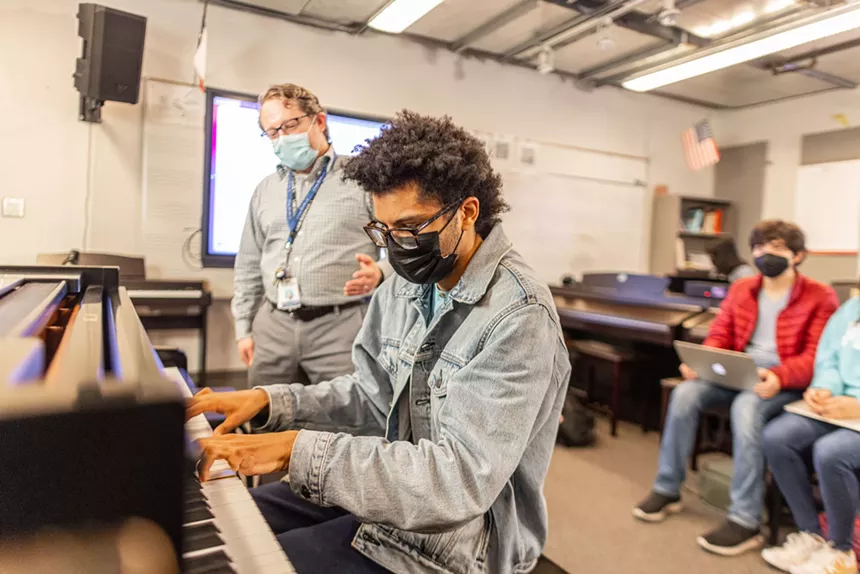
Pianoforte and music theory teacher Leonardo Zuno Fernández offers operation advice to his student.
Kathy Tran
"It's a really good group," says ballet and jazz dance teacher Kevin Butler during his forenoon warmups with a mixed course of freshmen and sophomores. "There's manner more talent at Booker T., so they have to be more challenged."
On the side by side floor up, the students in theater instructor Grand.T. D'Avignon's form are either sitting behind a sewing machine or piecing together a replica of an 18th century petticoat, dress and pannier for a University Interscholastic League competition that's just two days abroad. The students are so engrossed in their work and details that they don't seem to notice our presence.
Just downward the hall from them, the students in art teacher Krystal Read's class are preparing intricate designs for a printmaking projection, a circuitous medium fabricated from a multitude of materials that the Dallas Museum of Fine art described from a previous student exhibition equally "an act of construction."
"We get to work with specialized equipment and very specific classes," says Read, who'due south also a Booker T. graduate and the school's banana managing director for the visual arts solarium. "Nosotros're just keeping upwards with the pinnacle tier standards this school has. There'south a lot of pressure level for the teachers and students to perform likewise."
The tone rings and students wrap up their projects and belongings for their next classes. Senior Moses Turgeman strums a tune on a guitar as he walks up the stairs. This is a familiar sight and sound for the faculty and students.
"I'm gonna miss yous when y'all graduate," Sharon Cornell, the schoolhouse'south public relations specialist, tells him. "I similar hearing y'all in the halls."
A schoolhouse like Booker T. Washington is a rarity, showtime with its strong back up and focus on balancing creative and academic education for the 250 students who earn a spot each twelvemonth. It's a unique place that can boast of fostering and shaping the talents and minds of Grammy-winning artists such as Edie Brickell, Norah Jones, Erykah Badu, Roy Hargrove, Alan Emert and Danny O'Brian of Dauntless Combo, 18 members of the God's Property gospel choir and playwright Theodis "Ted" Polish, who recently earned the school its get-go Literary Landmark designation from the Texas Land Library and Archives Committee.
"I came from Catholic schoolhouse where I had to clothing uniforms every day," says Badu, who graduated from Booker T. in 1989 and sent her daughter Puma to the high school for its singing conservatory. "I felt like I wasn't able to really express myself aesthetically. And so when I got into Booker T. as a dancer, and I wasn't necessarily a dandy dancer just I was expressive enough to go far, it was a globe of freedom for me."
Some of its more famous students, like Badu, Jones and others, still bear witness up at times to sing and perform with the students and even bring forth other famous and talented names like Common, who stopped past the schoolhouse with Badu in 2019.
Booker T. Washington High School is now a century-old monument to the history and evolution of Dallas' culture.
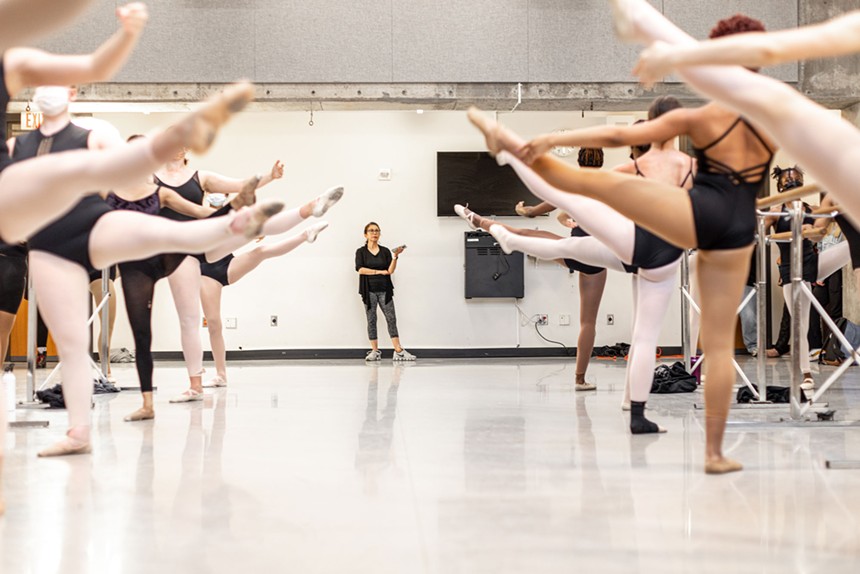
Trip the light fantastic toe instructor Estela Tejeda-Moreno gives her class dance position cues.
Kathy Tran
"It truly is the shoulders of the giants that we stand on," says Dr. Scott Rudes, Booker T.'south primary. "This school was founded by true pioneers who fought and prided themselves on receiving an education. They were visionaries. They were creators, and then to have the school transformed into an arts magnet that as well celebrates that innovation, creativity and commitment to pushing the envelope is a testament to the legacy of those that came earlier us."
The edifice that houses the Flora Street school in the heart of the Dallas Arts Commune opened on October. xxx, 1922 every bit a high school for African Americans, the only 1 in Dallas' segregated schoolhouse district for its first 17 years of existence, according to its historical landmark designation report.
The school added "Technical" to its title in 1952 following a $1 meg renovation, making it the commencement technical African American loftier schoolhouse in the Southwest. Some notable alumni from its "Bulldog years," referring to the school'south start mascot, include former DISD teacher and administrator Dr. Thomas Tolbert, pioneering Dallas Morn News columnist and journalist Julia Scott Reed and sports legends such as world welterweight battle champion Curtis Cokes and Major League Baseball Hall of Famer Ernie Banks, who's honored with a statue on the school'southward grounds.
The school accomplished many firsts in regional education: It was the first Dallas school to circulate a football game on radio, the first schoolhouse in the Southwest to teach an accredited course in African American life and history and the start to found a National Accolade Society chapter, according to historical reports.
"[Booker T.] was kind of different in a way considering before then nosotros were not allowed to do a whole lot of things," says Ruthie Walker, who graduated from Booker T. Washington Technical High School in 1967 and served as her graduating class' pupil council president. "It gave us a lot of opportunities to get jobs where we couldn't get them."
Even before the schoolhouse became an arts magnet, Booker T.'s students got a healthy dose of arts teaching and exposure, Walker says.
"We got to become to the opera," she says. "We got to go to the symphony. We got to do a whole lot of stuff we weren't introduced to at Grand.B. Polk [Elementary]."
Booker T. Washington closed in 1969 as part of a districtwide desegregation order. Dr. Paul Baker, a renowned theater teacher and 1 of the founders of the Dallas Theater Center (DTC) in 1959, led an endeavour to make Booker T. into an arts magnet school upon its reopening in 1976.
"Most of these schools exist because of a desegregation social club just like this one," says Guinea Bennett Price, an '89 alumnus of Booker T. who is as well the co-founder and co-artistic manager of the Soul Rep Theatre Company and the high schoolhouse's theater solarium director.
Nolan Estes became DISD's superintendent in 1968 and worked with Baker to establish an arts curriculum and program expansions for students and teachers. Louise Mosely Smith, a quondam head of the school's theater division who worked with Baker at DTC and his Children's Theater programme, wrote in an essay for the volume Paul Baker and the Integration of Abilities that new strategies in "career education" were existence implemented across the country to "engage the whole person or relate to life."

A student works on a multimedia art project.
Kathy Tran
This led to the creation of magnet schools such as the Skyline High School in 1971, which taught bookish subjects for half of the twenty-four hours and let students work on "applied projects in their chosen career field" for the rest of the day, Smith wrote.
The following year, Baker wrote a book called Integration of Abilities outlining methods and techniques he developed and implemented while education drama and theater at Trinity and Baylor University. Baker lays out new teaching techniques that use students' sensory sensation and creative expression across all mediums to assist students "discover their creative power" and "help the theater catch up with the progress made in the other arts," according to TSU archives.
DISD created an exploratory group called The Alliance that advised the district to create magnet schools focused in career curriculums such as science, business, constabulary and the arts. Baker became the director of the arts magnet school project and sought hundreds of thousands in funding to rent professional artists to advise and teach at the school, a decision he made afterwards attending a National Conference of Magnet Schools in Houston where he and Smith met the founder of the renowned Houston Loftier School for the Performing and Visual Arts, Ruth Denney, Smith wrote.
Meanwhile, the building for Booker T. Washington Loftier School had been out of operation since the desegregation club and was being used as a meeting space and storage facility for the district's PTA. Smith wrote they chose to visit the edifice as the starting time possible site because of its proximity to the DTC, and it immediately bowled them over with its possibilities.
"It was dearest at first sight and smell," Smith wrote. "Equally we walked through the halls with the high ceilings, the lovely wooden cabinets and floors and the courtyard next to the cafeteria, we envisioned a small theater in the onetime choir room and a drawing classroom in the quondam homemaking room; we began planning how to turn the auditorium with its balcony into a usable theater with a light berth and dressing rooms."
Following Booker T.'s get-go of operations, arts magnet schools started to pop up in other major cities through the rest of the tardily '70s, and that led to the creation of the non-profit Arts School Network in 1981, Toll says.
"A network was created and the Booker T. staff was there at the offset of that art network; nosotros were ane of the founding schools for that and information technology'southward still going strong to this day," she says. "That was a way for us to always sort of feel like sister schools, like we have a reciprocity program. If one of our kids, say their dad'south job moves to Washington, D.C., then [the Duke Ellington Schoolhouse for the Arts] without audience will allow our students to enroll. When Hurricane Katrina happened, we were able to have the [New Orleans Center for the Creative Arts] kids."
It took time for the diversity of Booker T.'s student body to abound post-obit its reopening. A lawsuit filed in 1970 in federal court by Sam Tasby confronting DISD showed that school districts similar Dallas were not meeting legal requirements for desegregation.
U.South. District Estimate Barefoot Sanders, who oversaw the instance for most of his long career on the bench, ruled in 2003 that the district achieved "unitary status" in "closing the accomplishment gap" even as and so-Superintendent Dr. Mike Moses noted in his testimony that "much remains to be done," co-ordinate to courtroom filings. DISD has a center school named in Tasby'due south honour.
"Information technology's changed exponentially in the last eight years," Toll says, referring to her time as a teacher at Booker T. Washington. "The twelvemonth I came in, in the senior class, there were zilch Black boys. In that location was one inferior and he left. So the side by side senior class didn't take one either, and my son's class had iv. I was determined that we would hold onto these four and have more every twelvemonth after that and every year, that number has gone up."
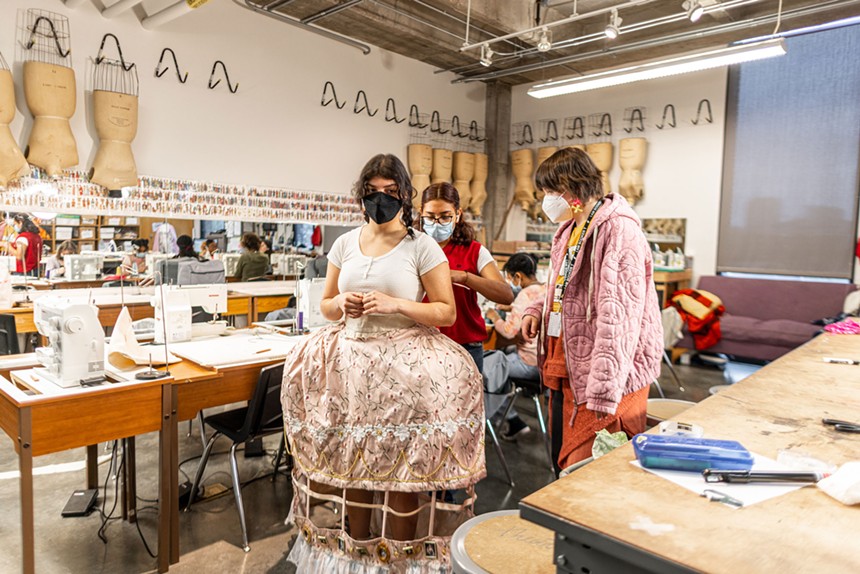
Dressmaking in a theater and sewing class.
Kathy Tran
Rudes says the school and the district remain committed to programs that aid them seek out "students who have talent, drive and passions in the various sectors of our urban center who may not have been immersed in the arts."
Booker T. Washington High School's curriculum consists of four creative "conservatories": theater, visual arts, music and dance in addition to bookish studies. Students who wish to attend the school must have at least a 75 percentage cumulative grade point boilerplate or 80 percentage for students from the commune'due south gifted and talented or science and technology schools. All DISD magnet schools also require students to place in a certain percentile on the State of Texas Assessments of Academic Readiness (STAAR) or the Measures of Academic Progress (MAP) tests depending upon the student'due south form level and school, co-ordinate to the commune's website.
Students who pass those bars participate in "in-person assessments" and must prove residency. DISD tried to crack downwards on students who filed false residency records in response to reports of rampant abuses of the rule in 2020 that included a tip hotline to weed out students who weren't living in the commune.
Thirty percent of the students are selected based on overall scores, and the other 70 percent go through the district's feeder pattern guidelines based on pupil populations with considerations given to siblings of current or graduated students "who [attend] the same Vanguard, magnet Montessori or Academy programme," according to the guidelines.
Rudes says the school receives strong, continuous back up from the district and the school'southward advisory board, the latter of which has been able to raise millions in individual donations for supplies, programs, renovation projects and expansions to its celebrated headquarters. The school boasts impressive numbers for student scholarships that reached as high as $78 million for a single graduating class.
"Information technology's pretty magical," says Kate Walker, the loftier school's dance conservatory director. "These kids are incredibly talented and go along me on my A-game. I learned pretty quick that I can't rest on my laurels in the same mode I don't expect them to. Information technology'due south helped me abound a lot as an instructor. The level of educational activity and talent is through the roof. I take to remind myself they are teenagers. As you're watching them, it'southward like shooting fish in a barrel to forget they're 13 or xiv years sometime .... and then someone will say something funny and y'all remember."
Artist Chris Arnold, who graduated from Booker T.'southward visual arts conservatory in 1984 and after founded Eyecon Studios with Jeff Garrison, now paints and restores multistory murals all over the metropolis and land, with works at the Southwest Airlines corporate headquarters and Walt Disney Earth resorts in Orlando. Ane of his showtime Dallas murals covered the side of a parking garage located across the street from Booker T. He says the things he learned from his art education at Booker T. showed him more than merely how to hold and use a paintbrush: They taught him and other students similar him how to be an artist.
"The staff at the school were all incredibly talented professionals and were willing to give of their time. They brought in their peers and young man artists to assistance teach the kids in a nurturing environment," Arnold says. "There were super passionate and really cared about educating the kids, and their passion rubbed off on us and definitely fired us upward. The school itself by its nature is a magnet school, so it draws people in and yous have to be actually on betoken and passionate most what you do to be in that schoolhouse."
An education with a strong focus on fostering and educational activity the fine art and exploration of expression doesn't merely accept application to students' technical abilities to become singers, actors, dancers or artists. Many of the school's staff members annotation that lessons in those areas can also teach skills like focus, problem solving, confidence and determination that apply to a wide variety of ventures and careers.
"That level of subject translates actually well into any career path," Walker says. "I see lots of students pave their ain way whether information technology's every bit artists or non. They are leaders."
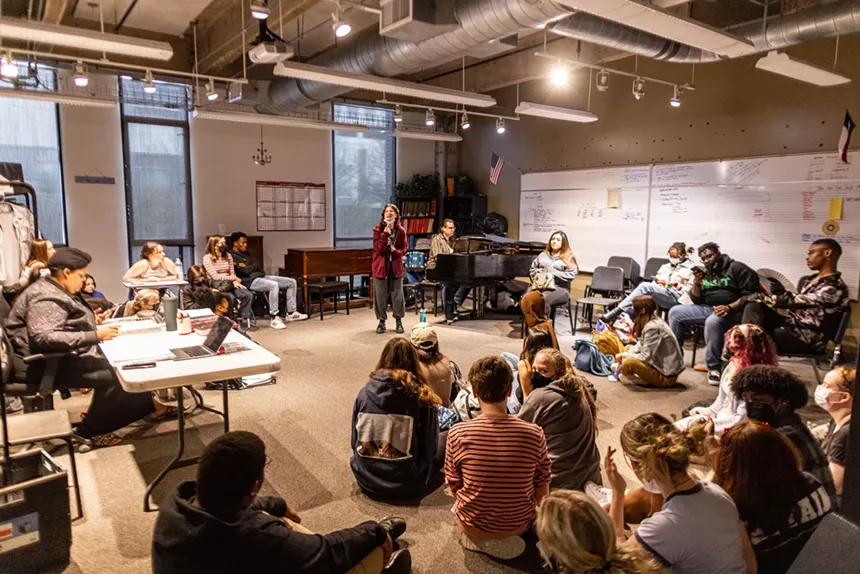
A drama course in session at Booker T. Washington high school.
Kathy Tran
The school already has a long and impressive list of names of people who piece of work in front of and backside the scenes in show concern, just they also include names similar Ford Motor Co. primary designer Earl Lucas, civil and labor chaser Tammy Wood of the Bell Nunnally law house of Dallas and WinCo Foods' corporate communications director Noah Fleisher.
"You're becoming empowered to exist your own creative person, to learn how you function as an artist," Price says. "What is my personal process? These four years helps you figure that out, and in one case you move beyond this space and someone throws a projection at you, you go into your systems that you developed in these four years and it simply makes putting things together only so much easier. Yous know the best way for yourself because you've had a risk to try information technology many means in collaboration by yourself and once you've got that, you lot can utilize information technology to anything."
Smith wrote that Baker's educational philosophy believed "every educatee is creative and that creativity applies to all areas of the pupil's life; therefore, every pupil should try every aspect of theater."
Arts magnets school like Booker T. Washington High School don't simply create artists. Badu says Booker T. brings out the artistic and expressive vision that's already there.
"That creativity and expressing myself in my mode kind of opened me up with every other artform," Badu says. "The freedom of those halls, it was a whole new world for equally the creative person in me was enkindling."
Source: https://www.dallasobserver.com/music/dallas-prestigious-booker-t-washington-high-school-for-the-performing-and-visual-arts-turns-100-13649955

ارسال یک نظر for "Booker T Washington for the Performing and Visual Arts"